
Time to change the narrative on demographics challenge:
By John Harrington
The scale of the peril posed to the GAA by Ireland’s shift from a predominantly rural society to an increasingly urbanised was thrown into stark relief today by the publication of the report of the Association’s National Demographics Committee.
The kernel of the issue is that rural GAA clubs are struggling to field teams because they just don’t have the numbers, while urban GAA clubs have major issues catering for the surging populations in their catchment areas.
It would be easy to be overawed by the challenge or take the view that there’s not much the GAA can do about such a societal shift, but the authors of the report believe we can fight this threat rather than take flight from it.
“For years and years and years, far too long, we have spoken about the demographic problems and some would suggest the sky is falling in and it’s the end of the Association as we know it,” says Chairperson of the GAA’s National Demographic Committee, Benny Hurl.
“We need to change that narrative away from the problems, that the sky’s falling in, to finding solutions. That’s the most important thing here because we can talk until the cows come home about the problems but it’s not going to solve anything, and unfortunately we have done that for far too long.
“It’s time to change the narrative and what’s been very interesting for us is actually the positivity that people have had around the demographic changes and actions that we’re proposing.
“It’s not doom and gloom. They’re recognising, yes, that there are challenges, especially in rural places where maybe there’s depopulation and clubs having an inability to play and field.
“But they’re actually seeing that some of the actions that are being proposed provides opportunity for those types of clubs to survive and maybe to thrive in their own way.
“And then as well as that in the more urban or suburban spaces, again, some of the actions that are proposed there are intended to help clubs with the difficulties that they have around facilities, around volunteers and being able to provide games for their community.
“So this is a positive, this is a good news story. This is not a doom and gloom, the world is falling in story.
“If the actions that we feel are appropriate can be implemented across clubs and counties and across the association, that there’s actually very, very positive futures for our clubs.”
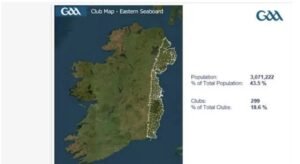
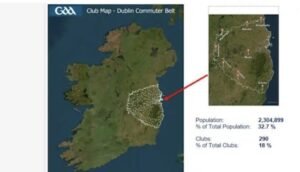
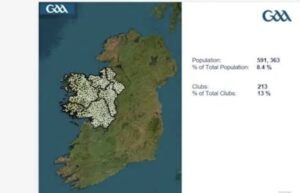
44 per cent of the island’s population is serviced by just 19 per cent of the country’s GAA clubs.
44 per cent of the island’s population is serviced by just 19 per cent of the country’s GAA clubs.
The actions proposed are both internal and external and anyone with an interest in the future of the GAA should read the report in full to be fully appraised of both the problems and potential remedies.
The internal actions include two motions that will be brought to Annual Congress next year that will make it easier for existing clubs to be retained.
Currently clubs must play adult championship in order to be recognised as a club and it’s proposed that playing in an underage championship on their own would suffice for a club to retain their status.
The second motion proposes that counties could provide championships for demographically challenged clubs on a fewer than 15-a-side basis.
Other proposed internal actions include targeted growth of new and existing clubs which would be helped by a new Club Support Unit, pilot initiatives in Kerry and Kildare focusing on rural areas with declining populations and growing urban centres in both counties, greater flexibility around transfer rules, and the establishment of a National GAA Facilities Strategy.
Benny Hurl believes a shift in mindset will be just as important as any policy change.
The GAA is built upon local rivalries and sometimes that can lend itself to a protectionist view rather than appreciate what the greater good might be.
For example, everyone in this country would agree that more housing developments are needed to cater for a growing population but many wouldn’t be happy if one sprung up in their ‘back yard’.
A similar sort of ‘NIMBYism’ can exist in the GAA. Even if an existing GAA club in a heavily populated urban area is only capable of reaching a small percentage of the people living there, we have seen some bitterly oppose the establishment of a new one in their area.
“Self-interest will decide whether this project succeeds or fails,” says Hurl. “We have to now prioritise the greater good rather than indulge in self-interest.
“I was delighted, absolutely delighted to hear the great John Fenton from Midleton in Cork say on RTE this week, ‘there’s 2,500 more houses being built here in Midleton and we’re going to get 10,000 more people into our town so we need another club’.
“I sincerely believe that before the Demographics officers came along, before this Demographics committee came along, that people would have thought in that way.
“But for me, it was very reassuring that John Fenton was able to say that to Marty Morrissey live on television. I think somebody of the stature of John Fenton, a club of the stature of Midleton, has basically given an example to all of the other bigger clubs that there is a bigger picture and there is a greater good.
“I go back to Covid times when we as GAA people, GAA members and volunteers in the community, we went and we looked after the most vulnerable in our society. We brought them parcels, we distributed food aid and PPE, you name it, we did it.
“We stepped up to the mark to look after the most vulnerable people in our society.
“If somebody died in the local GAA club down the way this evening we’d be out, we’d have our yellow coats on, we’d have our bibs on, we’d be stewarding, we’d be making tea, we’d be parking cars, we’d be doing all that sort of thing.
“Now what we need to do for those smaller clubs is do the exact same that we were doing in Covid. We would help them out in an emergency situation and addressing the recommendations and implementing the recommendations that’s contained within this report is doing exactly that.”
Externally, the GAA hopes to tackle the issue of demographics by building an all-island strategy to influence government and local authorities and in doing so secure zoning, development levies, and funding for GAA facilities.
A dual-use model would be pursued which would promote shared facility partnerships and rural social enterprise partnerships.
Changing demographics are a huge challenge for the government as they are the GAA, and Hurl believes great things can be achieved by working together instead of in silos.
“I do believe that collectively we have all been guilty of inaction,” says Hurl. “The GAA, governments, local authorities, everybody. I’m not saying that as a criticism of anyone, it’s just an observation.
“I do believe that the government now understands acutely the issues caused by demographics and that’s thanks to the work that we’re all doing highlighting the issues.
“I do believe that there is a willingness now within government and within local authorities and governments to address the issues. That’s Governments north and south, because we’re a 32-county organisation.
“There’s a willingness now in Government departments and with Government ministers to engage with us and there’s a willingness within the GAA to engage with them that maybe wasn’t there before. The next part of that will be delivery.
“The GAA and the government have always worked fairly well together, but at this stage what we would be saying is that in order to fully resolve the demographic challenges out there, that the GAA are not able to complete that task on their own, nor should they be expected to do that on their own.
“What we would be saying in this report is that we are the largest community supporting organisation in the country and we would like to partner with the government, and the government should partner with us to resolve our common issues.
“We have for years and years and years done very good work in our communities, and we’ll continue to do that, but in order to reverse the demographic trends the government are going to have to come in and amend some policies, like rural planning, their facilities in urban towns and cities.
“Perhaps because GAA is a very successful organisation many government departments and local authorities have taken the view that they don’t need any help, but in 2025 we need an awful lot of help in both rural and urban Ireland. Each have their own particular challenges and we can’t do it on our own, we need government intervention.”
The National Demographics Committee’s report warns the next decade will decide whether Gaelic games remains a vibrant force in Irish life or instead becomes fractured by demographic divides.
Benny Hurl is very optimistic the Association as a whole will respond positively to this call to arms.
“There have been many demographic and other reports written within the GAA and then not acted upon and potentially this could be yet another one and the only people who can determine whether that happens or not is ourselves, is our clubs, is our counties, they will decide whether there’s a positive outcome,” says Hurl.
“How optimistic are we? We are extremely optimistic. I’m an optimist by nature, and I do believe that there’s been a recognition, not only in the GAA, but outside of the GAA, and nationally, by everybody, that demographics have reached a tipping point for the GAA, for other sports, and for society as a whole something needs to be done.
“As far as the GAA are concerned, these are our proposals. We will be going out and we’ll be reaching out and meeting counties again, and we’ll be resolving things with counties in their own spaces. Alongside that, we will be engaging with government and local authorities more actively than ever before.
“So, in terms of optimism, yeah, we’re very optimistic, and we would like to think that this report will form the basis for not only the retention and preservation of so many small, rural and urban clubs, but it can be the catalyst for the development and growth of so many other clubs that are required in urban spaces.”
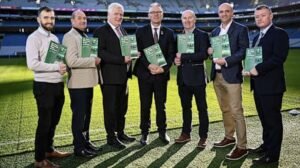
The report of the Association’s National Demographic Committee can be read in full and downloaded below.
Download The GAA’s Response to Ireland’s Demographic shift